
Hybrid Provider
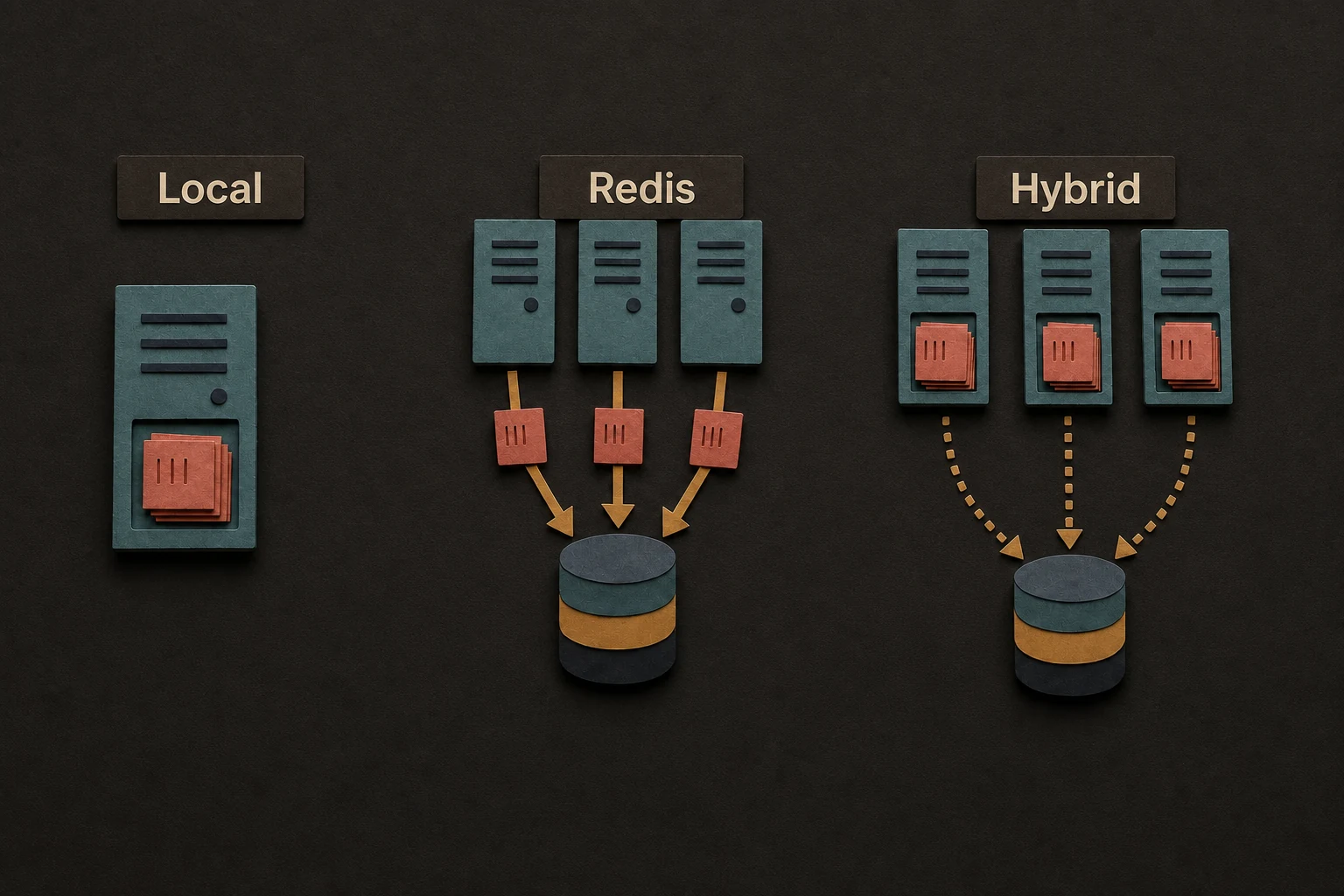
The hybrid provider combines the low latency of in-process state with the distributed consistency of Redis. It maintains a local counter per key and periodically flushes accumulated increments to Redis in batches via a background actor (the RedisCommitter). Between flushes, admission decisions are served from local state without any Redis I/O.
Access: rl.hybrid()
When to use
- High-throughput distributed APIs where per-request Redis round-trips are too expensive
- When you can tolerate up to
sync_interval_msof lag between local state and Redis - When you want sub-microsecond admission latency on the fast-path
If you need decisions that always reflect the latest Redis state, use the Redis Provider.
Requirements
- Redis >= 7.2
- One async runtime feature:
redis-tokioorredis-smol
Setup
The setup is identical to the Redis provider. The only difference is calling rl.hybrid() instead of rl.redis():
use std::sync::Arc;
use trypema::{
HardLimitFactor, RateGroupSizeMs, RateLimit, RateLimitDecision,
RateLimiter, RateLimiterOptions, SuppressionFactorCacheMs, WindowSizeSeconds,
};
use trypema::hybrid::SyncIntervalMs;
use trypema::local::LocalRateLimiterOptions;
use trypema::redis::{RedisKey, RedisRateLimiterOptions};
#[tokio::main]
async fn main() -> Result<(), trypema::TrypemaError> {
let client = redis::Client::open("redis://127.0.0.1:6379/").unwrap();
let connection_manager = client.get_connection_manager().await.unwrap();
let rl = Arc::new(RateLimiter::new(RateLimiterOptions {
local: LocalRateLimiterOptions {
window_size_seconds: WindowSizeSeconds::try_from(60).unwrap(),
rate_group_size_ms: RateGroupSizeMs::try_from(10).unwrap(),
hard_limit_factor: HardLimitFactor::try_from(1.5).unwrap(),
suppression_factor_cache_ms: SuppressionFactorCacheMs::default(),
},
redis: RedisRateLimiterOptions {
connection_manager,
prefix: None,
window_size_seconds: WindowSizeSeconds::try_from(60).unwrap(),
rate_group_size_ms: RateGroupSizeMs::try_from(10).unwrap(),
hard_limit_factor: HardLimitFactor::try_from(1.5).unwrap(),
suppression_factor_cache_ms: SuppressionFactorCacheMs::default(),
sync_interval_ms: SyncIntervalMs::try_from(10).unwrap(),
},
}));
rl.run_cleanup_loop();
let key = RedisKey::try_from("user_123".to_string())?;
let rate = RateLimit::try_from(10.0)?;
// Absolute: served from local state
let decision = rl.hybrid().absolute().inc(&key, &rate, 1).await?;
// Suppressed: probabilistic admission from local state
let decision = rl.hybrid().suppressed().inc(&key, &rate, 1).await?;
// Query suppression factor
let factor = rl.hybrid().suppressed().get_suppression_factor(&key).await?;
Ok(())
}
How it works
- First call for a key: The hybrid provider reads from Redis to initialise local state.
- Subsequent calls (fast-path): Admission decisions are made from local counters. No Redis I/O.
- Background sync: The
RedisCommitterperiodically (everysync_interval_ms) batches local increments and flushes them to Redis, then reads back the updated Redis state to refresh the local view. - State exhaustion: When local state indicates the key is at/over capacity, the provider reads from Redis to refresh and may transition to a different state.
State machine
Each key transitions through internal states. Understanding these helps reason about the hybrid provider's behaviour.
Absolute strategy
| State | Description |
|---|---|
Undefined | First call for this key. Reads Redis to initialise. |
Accepting | Below capacity. All requests allowed from local counter (no Redis I/O per request). |
Rejecting | Over capacity. Rejection cache based on oldest bucket's TTL. |
Suppressed strategy
| State | Description |
|---|---|
Undefined | First call for this key. Reads Redis to initialise. |
Accepting | Below capacity. All requests allowed from local state. |
Suppressing | At/above capacity. Probabilistic admission based on the suppression factor from the last Redis read. |
Suppressing state does not mean "all requests denied". It means the suppression factor is applied probabilistically: requests are admitted with probability 1.0 - suppression_factor. Only when the factor reaches 1.0 (over the hard limit) are all requests denied. This is the same algorithm as the local and Redis suppressed strategies.Thundering herd prevention
Each key has its own tokio::sync::Mutex. When local state is exhausted and a Redis read is needed, only one task performs the read; others wait on the mutex and then re-check the (now-refreshed) state. This prevents N concurrent tasks from all hitting Redis simultaneously for the same key.
The sync_interval_ms option
sync_interval_ms controls how often the background actor flushes local increments to Redis:
| Shorter (5-10ms) | Longer (50-100ms) |
|---|---|
| Less lag between local and Redis state | More lag |
| More frequent Redis writes | Fewer Redis writes |
| Higher Redis load | Lower Redis load |
Default: 10ms. Validated newtype: SyncIntervalMs::try_from(value) fails if value == 0.
A good rule of thumb: sync_interval_ms <= rate_group_size_ms.
sync_interval_ms. It is only used by the hybrid provider.Hybrid vs Redis: trade-offs
| Redis | Hybrid | |
|---|---|---|
| Fast-path latency | Network round-trip | Sub-microsecond |
| Redis load | 1 round-trip per inc() | Batched every sync_interval_ms |
| State freshness | Real-time | Up to sync_interval_ms lag |
| Best for | Accuracy-critical, low throughput | High throughput, latency-sensitive |
Key constraints
Hybrid uses RedisKey with the same validation rules as the Redis provider: non-empty, <= 255 bytes, no :. See Redis Provider for details.
Next steps
- Redis Provider -- the pure Redis alternative
- Local Provider -- in-process only
- Configuration & Tuning -- tune
sync_interval_msand other options