
Guides

Configuration & Tuning

Recommended defaults and trade-offs.

This page explains how to choose RateLimiterOptions values.

What you configure

Options are set per provider. You typically construct one RateLimiterOptions and share a RateLimiter.

use trypema::{HardLimitFactor, RateGroupSizeMs, RateLimiterOptions, SuppressionFactorCacheMs, WindowSizeSeconds};
use trypema::local::LocalRateLimiterOptions;
use trypema::redis::RedisRateLimiterOptions;

let options = RateLimiterOptions {
    local: LocalRateLimiterOptions {
        window_size_seconds: WindowSizeSeconds::try_from(60).unwrap(),
        rate_group_size_ms: RateGroupSizeMs::try_from(10).unwrap(),
        hard_limit_factor: HardLimitFactor::default(),
        suppression_factor_cache_ms: SuppressionFactorCacheMs::default(),
    },
    redis: RedisRateLimiterOptions {
        connection_manager: todo!("create redis::aio::ConnectionManager"),
        prefix: None,
        window_size_seconds: WindowSizeSeconds::try_from(60).unwrap(),
        rate_group_size_ms: RateGroupSizeMs::try_from(10).unwrap(),
        hard_limit_factor: HardLimitFactor::default(),
        suppression_factor_cache_ms: SuppressionFactorCacheMs::default(),
    },
};
let _ = options;

Knobs (per provider):

  • window_size_seconds
  • rate_group_size_ms
  • hard_limit_factor (suppressed strategy)
  • suppression_factor_cache_ms (suppressed strategy)
For the Redis provider, keep configuration identical across instances: window_size_seconds, rate_group_size_ms, hard_limit_factor, and suppression_factor_cache_ms.

This is a good baseline for most APIs:

  • window_size_seconds = 60
  • rate_group_size_ms = 10
  • hard_limit_factor = 1.5 (suppressed)
  • suppression_factor_cache_ms = 100ms (suppressed)

Knobs

window_size_seconds

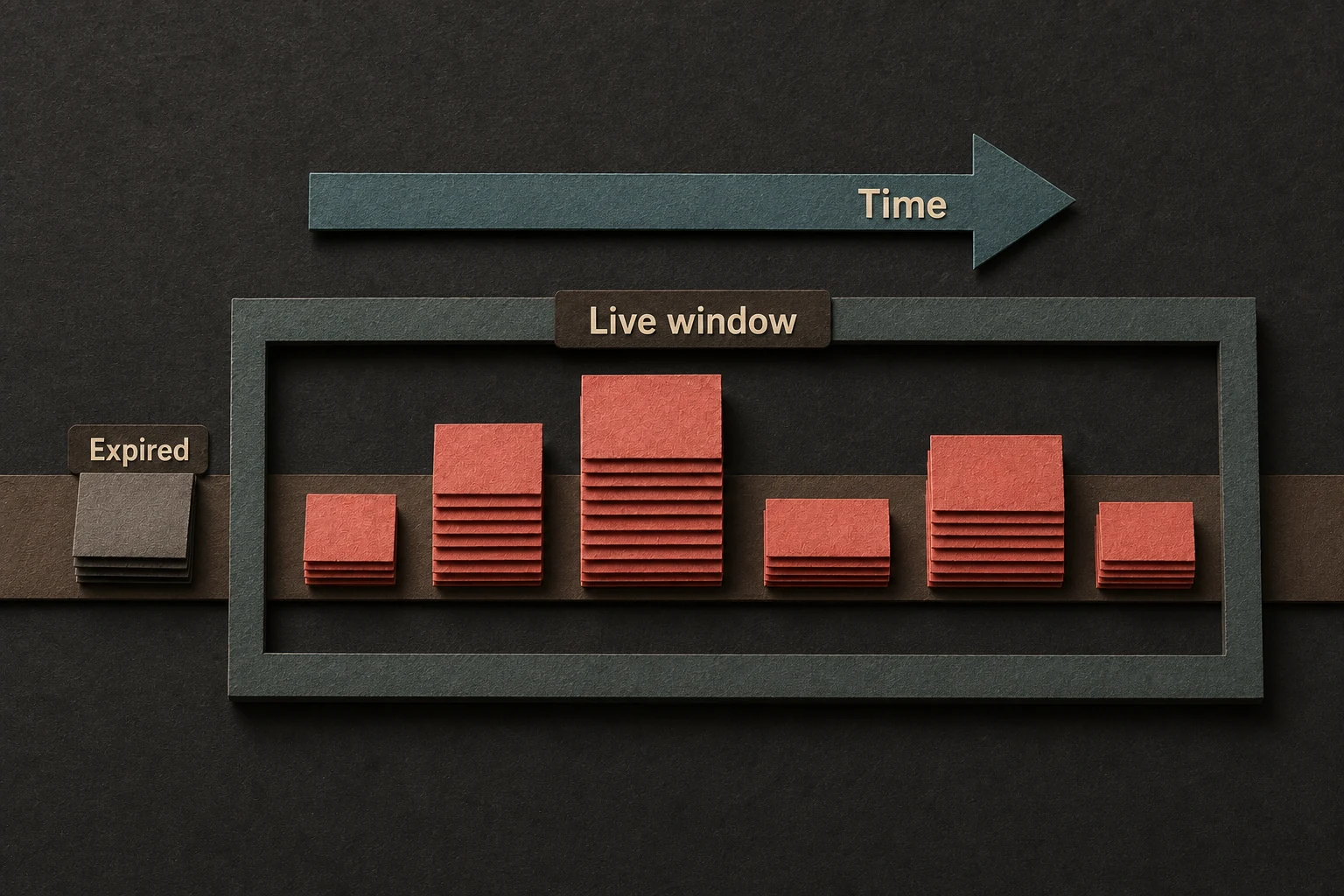
Sliding-window duration.

  • Larger: smoother decisions, slower recovery.
  • Smaller: faster recovery, more sensitive to bursts.

rate_group_size_ms

Bucket coalescing interval.

  • Smaller: more precise window accounting and retry hints, more buckets.
  • Larger: lower overhead, less precise retry hints.

hard_limit_factor (suppressed)

Hard cutoff multiplier used by the suppressed strategy:

hard_limit = rate_limit * hard_limit_factor

When the accepted series exceeds the hard limit, the result is Rejected { ... }.

suppression_factor_cache_ms (suppressed)

How long the suppressed strategy reuses a computed suppression factor for a key.

  • Local: an in-memory cache duration per key.
  • Redis: the TTL of the cached suppression factor stored in Redis.

It is a validated newtype (SuppressionFactorCacheMs): SuppressionFactorCacheMs::try_from(value) fails if value == 0. Default is 100ms.

use trypema::SuppressionFactorCacheMs;

let cache_ms = SuppressionFactorCacheMs::try_from(250).unwrap();
let _ = cache_ms;

Presets

Absolute (strict allow/reject):

ScenarioSuggested starting point
Typical APIwindow_size_seconds = 60, rate_group_size_ms = 10
Very latency-sensitivewindow_size_seconds = 30, rate_group_size_ms = 1..5
High throughput + many keyswindow_size_seconds = 60..120, rate_group_size_ms = 50..100

Suppressed (probabilistic near capacity):

ScenarioSuggested starting point
Typical APIwindow_size_seconds = 60, rate_group_size_ms = 10, hard_limit_factor = 1.5, suppression_factor_cache_ms = 100
Sharp spikeswindow_size_seconds = 30..60, rate_group_size_ms = 5..10, hard_limit_factor = 1.5..2.0, suppression_factor_cache_ms = 50..100
High throughput + many keyswindow_size_seconds = 60..120, rate_group_size_ms = 50..100, hard_limit_factor = 1.5, suppression_factor_cache_ms = 100..250

Rules of thumb

  • If you want faster recovery from bursts: reduce window_size_seconds.
  • If you need more precise retry hints: reduce rate_group_size_ms.
  • If suppressed rejects too early: increase hard_limit_factor slightly.
  • If suppressed reacts too slowly to spikes: reduce suppression_factor_cache_ms (at the cost of more recomputation / Redis reads).

Gotchas

  • For both providers, is_allowed(...) then later inc(...) is a check-then-act pattern and is not atomic.
  • If your goal is to admit and record, call inc(...) directly and use its returned RateLimitDecision; admission is evaluated as part of inc(...).
  • For the local provider, state is per-process and is not shared across instances.